Spiders | FastSEO Guru - Free Printable Coloring Pages for Kids
Free Spider Coloring Pages – Halloween Spiders, Webs & Cute Drawings to Color for Kids
Our Spider Coloring Pages collection brings together free, printable spider designs for children of all ages. Whether you are looking for cute drawings to color for toddlers and preschoolers, easy colouring sheets featuring friendly , or detailed web scenes for older kids and adults, every page in this collection is completely free to download and print at home or in the classroom. Spiders are one of Halloween's most recognizable symbols – and one of the most fascinating creatures in the natural – making these coloring worksheets as educational as they are fun.
0 Topics0 Coloring Pages
🖼️
No coloring pages in this category yet
Be the first to upload a coloring page to the Spiders category!
and – A Creepy Crawly Classic
Spiders and their webs are among the most instantly recognizable Halloween decorations in the . Fake webs draped across hedges, doorways, and windows, alongside rubber spiders dangling from ceilings, have become a standard part of Halloween decoration worldwide. Our spider coloring pages capture every side of this fascinating creature – from cute drawings to color for young toddlers and preschoolers to dramatic Halloween web scenes packed with detail for older children and adults who enjoy detailed colouring sheets.
The association between spiders and Halloween developed naturally from the spider's reputation as a creature of dark, abandoned places – cobwebs collecting in forgotten corners, spiders lurking in shadows, webs glistening in moonlight. These images connected naturally to Halloween's themes of haunted houses, graveyards, and the supernatural.
The History of Spiders and Halloween
Spiders, Witches, and the Middle Ages
The historical connection between spiders and Halloween runs through the same thread of medieval folklore that linked black cats and witches to the season. During the Middle Ages, spiders were widely associated with witchcraft and the supernatural in European folk belief. Witches were said to use spider webs as ingredients in spells and potions, and the sight of a spider on Halloween night was considered by some to be a sign that the spirit of a deceased relative was watching over the living.
This combination of witchcraft associations, dark habitats, and the eerie visual quality of a spider web glistening in candlelight placed the spider firmly within the Halloween tradition alongside ghosts, witches, and bats.
Spiders in Myth and Legend
Spiders have played a significant role in the mythology and folklore of cultures around the world for thousands of years. In ancient Greek mythology, the story of Arachne – a mortal weaver so skilled that she challenged the goddess Athena to a weaving contest – gave spiders their scientific name. Athena was angry at Arachne's pride and transformed her into a spider, condemned to weave webs for the rest of her life. The scientific name for the class of animals that includes spiders – Arachnida – comes directly from this ancient myth.
In West African and Caribbean storytelling traditions, Anansi the spider is one of the most beloved trickster figures in all of world folklore – a clever, cunning character who uses wit and cunning to outsmart larger and more powerful opponents. This tradition was carried to the Americas through the transatlantic slave trade and remains an important part of Caribbean and African-American folk culture.
Spiders in Popular Culture
Spiders have inspired some of the most beloved characters in children's literature and popular culture. Charlotte, the spider in E.B. White's 1952 children's novel Charlotte's Web, is one of the most celebrated animal characters in American literature. In 1962, Amazing Fantasy #15 introduced Peter Parker, a teenager bitten by a radioactive spider who becomes the superhero Spider-Man – one of the most recognized fictional characters in the world today.
These positive cultural associations make spider coloring pages a wonderful bridge between Halloween fun and broader literary and cultural discussions that children of all ages can engage with.
Amazing Spider Facts for Kids – Science Behind the Symbol
Spiders are far more extraordinary in real life than their Halloween reputation suggests. Spiders are arachnids – not insects – belonging to the class of animals called Arachnida. Unlike insects, which have six legs, spiders have eight legs and two main body parts. There are approximately 45,000 known species of spider worldwide, living on every continent except Antarctica.
Every spider produces silk, though not every spider spins a web. Spider silk is one of the strongest natural materials known to science – weight for weight, it is stronger than steel. Some spiders spin a fresh web every single night, eating the old web to recycle the protein used to make it.
Spiders cannot eat solid food – they must liquefy their prey by injecting it with digestive enzymes before swallowing it. Spider bodies produce a special oil that prevents them from sticking to their own webs. These extraordinary natural facts make spider coloring worksheets an ideal cross-curricular activity, combining Halloween art with genuine science learning about animal biology and adaptation.
Spider Coloring Pages as Learning Worksheets for Preschool and Toddlers
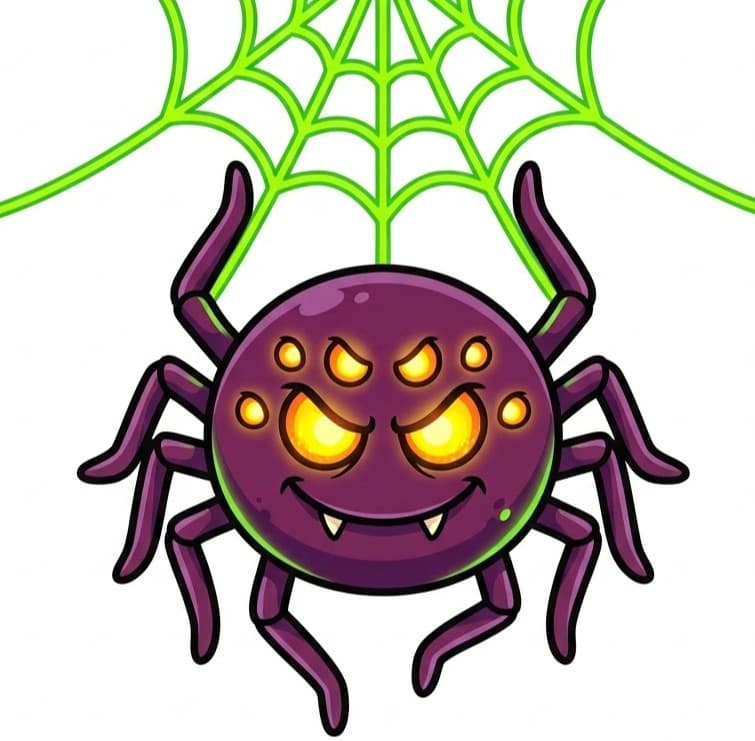
Spider images to color are among the most effective early learning tools in any Halloween coloring collection. The bold, round body and eight clearly defined legs of a cartoon spider make it an ideal easy coloring page for toddlers and preschoolers who are developing their fine motor skills and pencil grip.
Parents and teachers can use spider colouring sheets as a starting point for simple science conversations – asking young children how many legs a spider has, what a spider web is made of, and how spiders are different from insects. These conversations turn a simple printable activity worksheet into a genuine early learning experience that builds counting skills, vocabulary, and scientific curiosity alongside creativity and fine motor development.
Spider web designs also work beautifully as pattern recognition and fine motor exercises for preschool and toddler groups – tracing the lines of a web from center to edge is an excellent pencil control activity for young children.
How to Use Spider Coloring Pages at Home and in the Classroom
At Home
Set up a Halloween coloring station with spider pages alongside black markers and bold colored pencils for dramatic web effects. While children color their cute drawings to color, share simple spider facts – how many legs a spider has, why spider silk is so strong, and how a spider builds its web. Completed spider pages make striking Halloween window decorations and work beautifully displayed alongside bat and haunted house pages from this collection.
In the Classroom
Spider colouring sheets work excellently as Halloween party activity stations, early finisher tasks, and cross-curricular science and art lessons throughout October. Teachers can use spider coloring worksheets to introduce lessons on arachnids versus insects, animal classification, and natural materials. Older students can research different spider species, explore the mythology of Arachne, or discuss the role of spiders in literature through Charlotte's Web. For preschool and toddler groups, simple spider outlines work beautifully as easy coloring pages paired with counting activities – counting the eight legs is a natural and fun introduction to number recognition.
Printing Tips for the Best Results
Print on white cardstock paper for the crispest lines and most satisfying colouring experience. Set your printer to Fit to Page and High Quality for the sharpest output. All pages fit both US Letter (8.5 x 11 in) and A4 paper – making them ideal colouring in pages for both home and classroom use worldwide.
Classic Halloween spider colors work beautifully – deep black for the spider body and web, with vivid orange, purple, or deep blue for the background. For cute cartoon spider drawings to color, younger children can experiment with any colors they like – a bright red spider with a rainbow web makes for wonderfully creative and unique Halloween artwork.
Short Fun Facts – Spiders and Halloween 🕷️🎃
Spiders are arachnids, not insects – they have eight legs and two main body parts, while insects have six legs and three body parts.
The scientific name for the class of animals that includes spiders – Arachnida – comes from the ancient Greek myth of Arachne, a mortal weaver transformed into a spider by the goddess Athena.
There are approximately 45,000 known species of spider worldwide, living on every continent except Antarctica.
Spider silk is one of the strongest natural materials known to science – weight for weight, it is stronger than steel, yet flexible enough to stretch without breaking.
Some spiders spin a fresh web every night, eating the old web to recycle the protein used to build it.
During the Middle Ages, spiders were associated with witchcraft in European folk belief – and seeing a spider on Halloween night was considered by some to be a sign that the spirit of a deceased relative was nearby.
The Anansi spider is one of the most beloved trickster figures in West African and Caribbean folklore, a clever character whose stories were carried to the Americas and remain an important part of Caribbean and African-American folk culture.
Spider bodies produce a special oil that prevents them from sticking to their own webs – without it, a spider would be caught in its own trap.
Why Kids Love Spider Coloring Pages
Spiders are one of those wonderfully versatile Halloween subjects that work equally well as a spooky symbol and as a genuine science and nature topic – and children respond to both. The bold round body and eight clearly defined legs of a cartoon spider make spider designs some of the most satisfying and easy coloring pages for toddlers and preschoolers, while detailed web scenes with atmospheric Halloween backgrounds offer a dramatic challenge for older children and adults. Coloring spider images to color builds fine motor skills, encourages creative color choices, and gives children a satisfying screen-free activity that connects naturally to both the fun of Halloween and the genuine wonder of the natural world. Spider colouring sheets also spark natural curiosity – prompting children to count spider legs, ask how webs are made, and discover why an animal with such a spooky Halloween reputation is actually one of the most beneficial and extraordinary creatures in nature.
Frequently Asked Questions
Are these spider coloring pages free to print?
Yes, every page in this collection is completely free to download and print. No account or payment is required.
What paper size do these coloring sheets fit?
All pages fit both US Letter (8.5 x 11 in) and A4 paper perfectly – ideal colouring in pages for home and classroom use worldwide.
What age group are spider coloring pages best for?
Simple cartoon spider designs make excellent easy coloring pages for toddlers from around age 2 and preschool children, while more detailed Halloween web scenes work well for children aged 6 and up and older children and adults who enjoy detailed colouring sheets.
Why are spiders associated with Halloween?
Spiders became part of Halloween imagery through their medieval associations with witchcraft and dark, abandoned places. Their webs, dark coloring, and preference for shadowy corners connected naturally to Halloween's themes of haunted houses, the supernatural, and the eerie atmosphere of October nights.
Are spiders insects?
No. Spiders are arachnids, not insects. Insects have six legs and three body parts, while spiders have eight legs and two main body parts. The class of animals that includes spiders is called Arachnida, named after the ancient Greek myth of Arachne.
What colors should my child use for a spider coloring page?
Classic Halloween black works beautifully for spider bodies and webs, with vivid orange, purple, or deep blue for backgrounds. For younger children using these as easy drawings to color, any bright colors they choose make for wonderfully creative Halloween artwork – a pink spider with a yellow web is just as valid a creative choice.
Can spider coloring pages be used as science worksheets?
Absolutely. Spider colouring sheets work excellently as cross-curricular learning worksheets combining art and science. Teachers can pair them with lessons on arachnids versus insects, classification, and natural materials such as spider silk. They are free to print for personal and classroom use.
How many legs does a spider have?
have eight legs – which is one of the key differences between spiders and insects, which have six legs. Counting a spider's legs on a coloring page is a natural and fun number recognition activity for toddlers and preschool children.